
Forecasts are inputs, not answers
Energy infrastructure operates over long periods, while electricity markets can change quickly.
Prices, demand, renewable output, network conditions and market behaviour will not follow a single predetermined path.
Forecasting can help provide a structured view of those possible conditions.
But the objective is not to produce a precise prediction of the future.
It is to understand the range of environments in which an asset may need to operate.
A project should not depend on one favourable outlook
A forecast can make almost any project look attractive if the assumptions are sufficiently optimistic.
Infrastructure underwriting requires a different approach.
DERCO considers project economics across a range of potential market and operating conditions rather than relying on a single central forecast.
That means asking questions such as:
- What happens if market conditions are weaker than expected?
- Which assumptions have the greatest effect on project economics?
- How much of the investment case depends on variables outside the project's control?
- Does the opportunity remain credible under less favourable conditions?
The purpose is not to eliminate uncertainty. It is to understand it before capital is committed.
Physical reality still comes first
Forecasting cannot make an unsuitable site suitable.
A project's underlying physical and commercial conditions remain fundamental:
Load
How and when the facility uses electricity.
Connection
What the site's electrical infrastructure and network relationship can support.
Asset design
Whether the proposed system is appropriate for the site.
Commercial structure
How value, obligations and risk are allocated over the life of the project.
Forecasts sit around those fundamentals. They do not replace them.
This is an important point because it ties Perspective 04 directly back into the other three articles.
Test the range, not just the midpoint
A central forecast is useful for comparison, but infrastructure decisions should also consider what happens away from that central case.
DERCO uses forecasting and scenario analysis to consider how changing market and operating conditions may affect project economics over time.
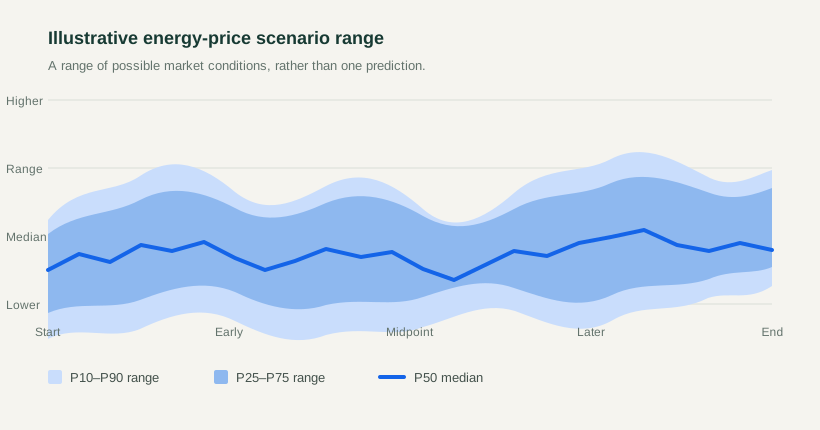
Forecasts are tested against historical outcomes and considered alongside scenario-based downside analysis.
This helps distinguish between an opportunity that requires a narrow set of favourable assumptions and one capable of remaining credible across a broader range of conditions.
Better forecasting should lead to better questions
The value of forecasting is not that it removes uncertainty. It is that it allows uncertainty to be examined more systematically.
For DERCO, the important output is therefore not simply a projected electricity price or revenue number.
It is a better understanding of:
- where an investment case is sensitive;
- what conditions could challenge it;
- which assumptions deserve further diligence; and
- whether the potential return is appropriate for the risk being taken.
That makes forecasting part of the investment process rather than a substitute for it.
DERCO's perspective
Distributed-energy infrastructure sits at the intersection of physical assets and changing electricity markets.
Both need to be understood.
Forecasting provides evidence about the environment an asset may operate within. Site analysis establishes what the asset can physically do. Commercial structure determines how value and risk are shared.
The investment decision comes from considering those elements together.
Forecast the range. Underwrite the asset.